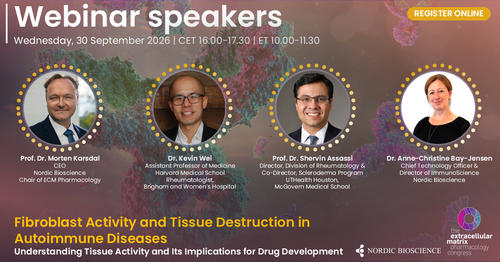
Fibroblast Activity and Tissue Destruction in Rheumatology: Understanding Tissue Activity and Its Implications for Drug Development
Fibrogenesis, fibroblast activity and tissue destruction and its relevance in autoimmunity, PsA, RA, SSc and lupus
The body continuously regenerates, which inherently means that tissue is constantly being broken down and formed. In autoimmune diseases we usually focus on inflammation and immune activity, but inflammation is what starts the process, not what causes the lasting harm. The damage comes when that balance tips, fibroblasts become activated, and cartilage, bone, and connective tissue are broken down faster than the body can repair them.
Join us to explore how evaluating tissue activity reveals what is actively happening in the disease biology, whether a treatment is truly working, and how these insights can support the development of better therapies in autoimmunity, PsA, RA, SSc and lupus.
Learn more
The body continuously regenerates, which inherently means that tissue is constantly being broken down and formed. In autoimmune diseases we usually focus on inflammation and immune activity, but inflammation is what starts the process, not what causes the lasting harm. The damage comes when that balance tips, fibroblasts become activated, and cartilage, bone, and connective tissue are broken down faster than the body can repair them.
Join us to explore how evaluating tissue activity reveals what is actively happening in the disease biology, whether a treatment is truly working, and how these insights can support the development of better therapies in autoimmunity, PsA, RA, SSc and lupus.
Learn more